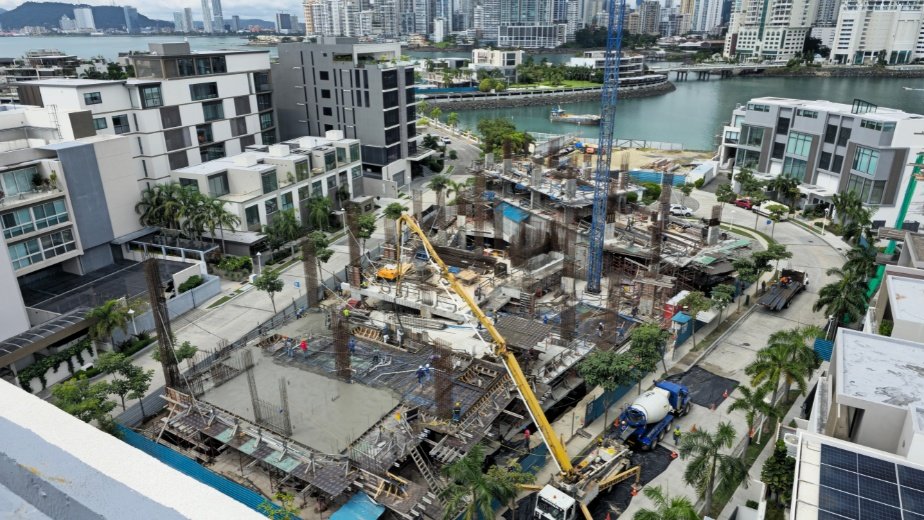
Unbonded mono-strand post-tensioned slabs are among the structural solutions that have transformed how buildings, parking structures, hotels, shopping centers, residential towers, and other reinforced concrete projects are designed and built.
This system optimizes the structural behavior of slabs by using high-strength steel cables, known as strands, which are tensioned after the concrete is placed to introduce controlled compressive forces into the structural element.
At ConstructHUBS, we cover this type of solution in our applied civil engineering articles, with the goal of bringing technical, practical, and useful information to the construction industry on structural systems, materials, construction processes, and innovation on site.
For this article, we draw on the experience of PT Solutions Panama, a company specializing in post-tensioning, pre-tensioning, structural systems, and technical services for construction projects.
You can also learn more about the unbonded mono-strand post-tensioning service offered by PT Solutions Panama (in Spanish).
What are unbonded mono-strand post-tensioned slabs?
Unbonded mono-strand post-tensioned slabs are concrete structural elements that incorporate high-strength steel cables within the slab. These cables are placed along a profile defined by the structural design and are then tensioned with specialized equipment once the concrete reaches the required strength.
The term “mono-strand” refers to using a single strand per individual duct or sheathing. In an unbonded system, the cable is protected by a special grease and a plastic sheathing that prevents direct bond between the strand and the concrete.
This configuration allows the cable to elongate during stressing and transfer forces to the concrete through the anchorages at each end.
How the unbonded post-tensioning system works
The principle of post-tensioning is to apply a compressive force to the concrete to improve its behavior under service loads. In a conventional slab, the concrete works mainly in compression and the reinforcing steel helps resist tensile stresses.
In a post-tensioned slab, the strands are stressed to induce an internal force that helps control deflections, reduce cracking, and improve the element’s structural efficiency.
The general process includes placing the cables according to the post-tensioning drawings, installing anchorages, placing and curing the concrete, stressing with hydraulic jacks, verifying elongations, and sealing or protecting the anchorage points.
Advantages of post-tensioned slabs in buildings
One of the main advantages of unbonded mono-strand post-tensioned slabs is the ability to achieve longer spans and more flexible interior spaces. This reduces the number of intermediate columns and improves the project’s architectural functionality.
They can also help reduce slab thickness, optimize the use of concrete and mild reinforcing steel, control deformations, and improve performance under service loads.
In projects such as parking structures, residential buildings, hotels, and offices, this flexibility can be a major advantage for laying out spaces, ramps, common areas, circulation, and parking.
Common applications of mono-strand post-tensioning
The unbonded mono-strand post-tensioning system is frequently used on projects that require structural efficiency, faster construction, and greater architectural freedom.
Common applications include slabs for residential buildings, office towers, hotels, shopping centers, elevated parking structures, podiums, amenity areas, and structures with specific deflection control requirements.
Its use should always be backed by specialized structural design, proper construction planning, and trained personnel for installing, stressing, and technically controlling the system.
Main system components
An unbonded mono-strand post-tensioned slab consists of several elements that work together to ensure system performance.
The main components include high-strength steel strands, protective plastic sheathing, corrosion-inhibiting grease, live and dead-end anchorages, wedges, placement accessories, pocket formers, and supplementary conventional reinforcement.
Each component must meet the project specifications and be installed according to the technical criteria defined in the drawings and construction procedures.
The importance of structural design and site coordination
The success of a post-tensioned slab depends not only on the system itself but on proper coordination between design, supply, installation, inspection, and execution.
Post-tensioning drawings must be coordinated with architecture, structure, MEP systems, openings, penetrations, joints, slab edges, and construction sequences. A conflict that is not caught in time can lead to field changes, delays, or technical risks during construction.
That is why early coordination is essential to ensure the cables are placed correctly, follow their profiles, maintain proper cover, and do not interfere with other project elements.
Stressing, elongations, and quality control
Stressing is one of the most important stages of the system. It is carried out with specialized hydraulic equipment and must be done once the concrete reaches the strength required by the design.
During stressing, controlled forces are applied to the strands and the resulting elongations are verified. These measurements make it possible to compare the cable’s actual behavior with the values expected from the design and the project’s technical procedures.
Quality control at this stage is essential to ensure the system works properly. Technical inspection, elongation records, equipment calibration, and final anchorage protection are all part of the quality assurance process.
Benefits for developers, designers, and builders
From the developer’s perspective, post-tensioned slabs can add value to a project by enabling more functional spaces, better use of floor area, and more efficient structural solutions.
For architects and designers, the system allows greater freedom in laying out spaces and resolving long spans. For builders, proper implementation can help streamline processes, reduce conflicts, and improve construction planning.
However, these benefits are only achieved when the system is designed, installed, and inspected by teams with technical experience in post-tensioning.
Technical considerations before using the system
Before using unbonded mono-strand post-tensioned slabs on a project, the structural, architectural, and construction conditions of the job must be evaluated.
Factors such as spans, loads, building use, column layout, serviceability requirements, construction schedule, equipment availability, pour sequence, and the experience of the construction team directly affect the system’s feasibility.
Post-tensioning should not be seen as an isolated solution, but as part of a comprehensive structural strategy that requires analysis, coordination, and control.
Conclusion: a technical solution for building more efficiently
Unbonded mono-strand post-tensioned slabs are an efficient alternative for projects that aim to optimize concrete use, improve structural performance, and create more flexible spaces.
When applied correctly, they help control deflections, reduce cracking, extend spans, and add technical value to residential, commercial, institutional, and parking buildings.
At ConstructHUBS, we continue to highlight solutions, companies, and technical knowledge that drive more efficient, safe, and innovative construction in the region.