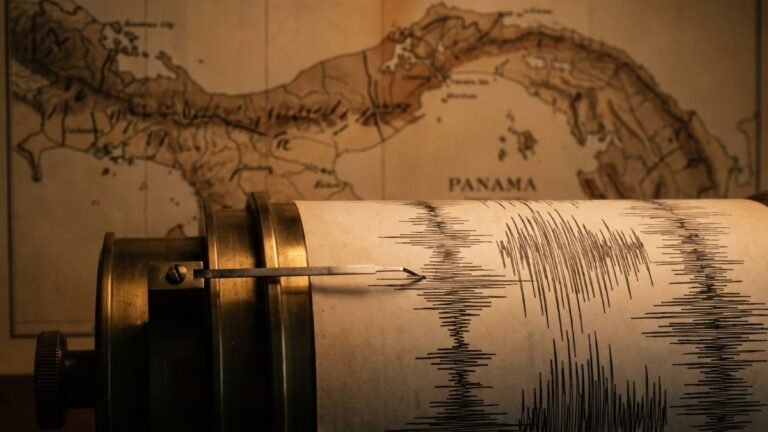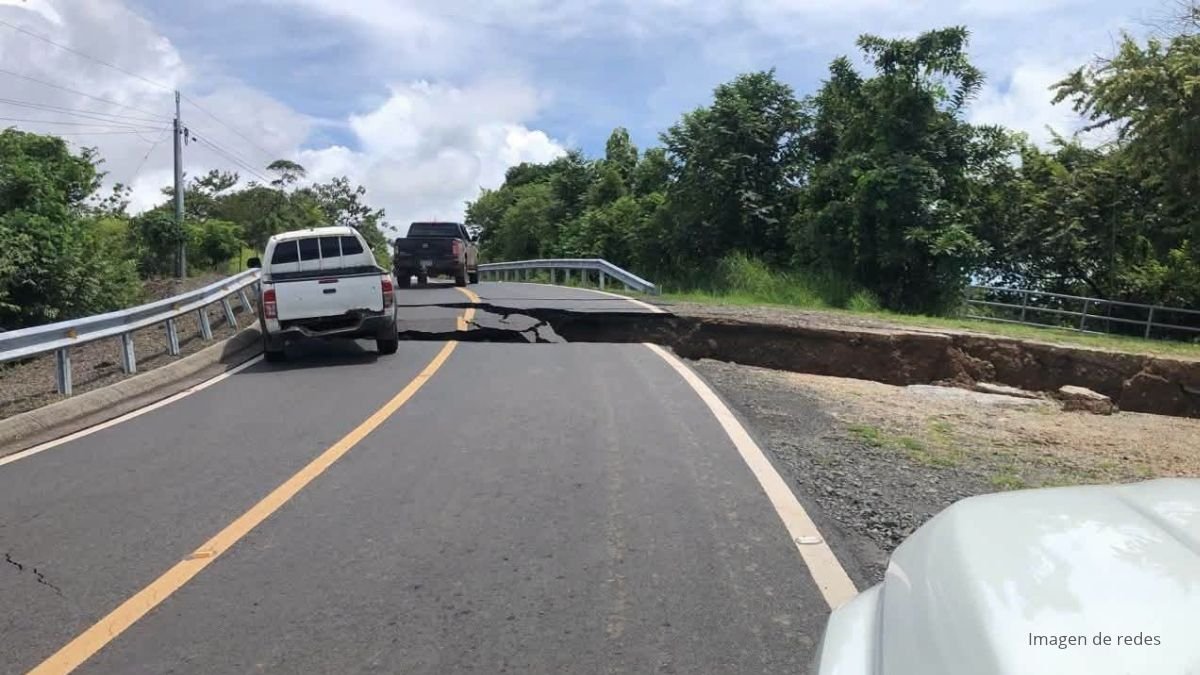
The 2026 Panama earthquake was a magnitude 7.7 quake that struck the Azuero Peninsula on Friday, October 9, at 12:56 p.m. It is the largest earthquake ever recorded in the country. According to the official report from Panama’s National Civil Protection System (Sinaproc) as of October 16, it affected more than 20,000 people, more than 7,000 homes were assessed for damage, 27 people were injured, and one person died.
In this article, we summarize what happened, where the damage was concentrated, how the aftershocks have evolved, and what lessons the 2026 Panama earthquake holds for those who design, build, and maintain buildings in the country.
2026 Panama earthquake: what happened on October 9
- Time: 12:56 p.m. Panama time. The strong shaking lasted about one minute.
- Magnitude: 7.7 according to the U.S. Geological Survey (USGS). The Institute of Geosciences at the University of Panama first reported it as 7.2 and later revised it to 7.5. The difference comes from the different calculation methods each agency uses.
- Epicenter: about 39 km (24 miles) northwest of Tonosí, near the border between Los Santos and Veraguas. The USGS places it 12 km from Pitaloza Arriba.
- Depth: very shallow, between 4 and 13 km depending on the agency. Shallow earthquakes are felt more strongly near the epicenter.
- Fault type: the USGS classifies it as a strike-slip earthquake (horizontal movement). Scientists are still studying which specific fault ruptured.
- Tsunami: precautionary alerts were issued for the Pacific, but no tsunami was generated.
The earthquake was felt throughout the country and also in Costa Rica and Colombia. In Panama City, thousands of people evacuated buildings. The Panama Canal reported that its operations were not affected.
Official damage report
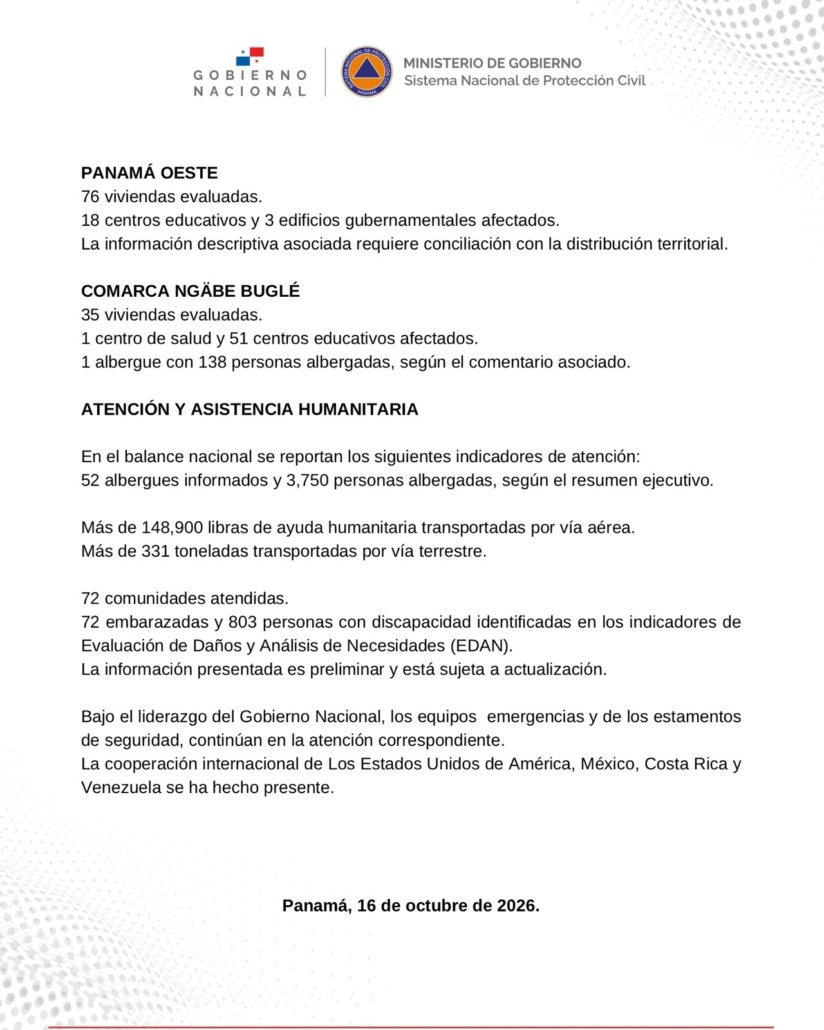
These figures come from official bulletin No. 14 of Sinaproc’s Emergency Operations Center, as of October 16, 2026. They are preliminary and may change as assessments continue.
| Indicator | Figure |
|---|---|
| People affected | More than 20,000 |
| Deaths | 1 (Los Santos) |
| Injured | 27 |
| Homes assessed | 7,406 |
| Schools affected | 619 |
| Health facilities affected | 42 |
| Shelters opened | 52, housing about 3,750 people |
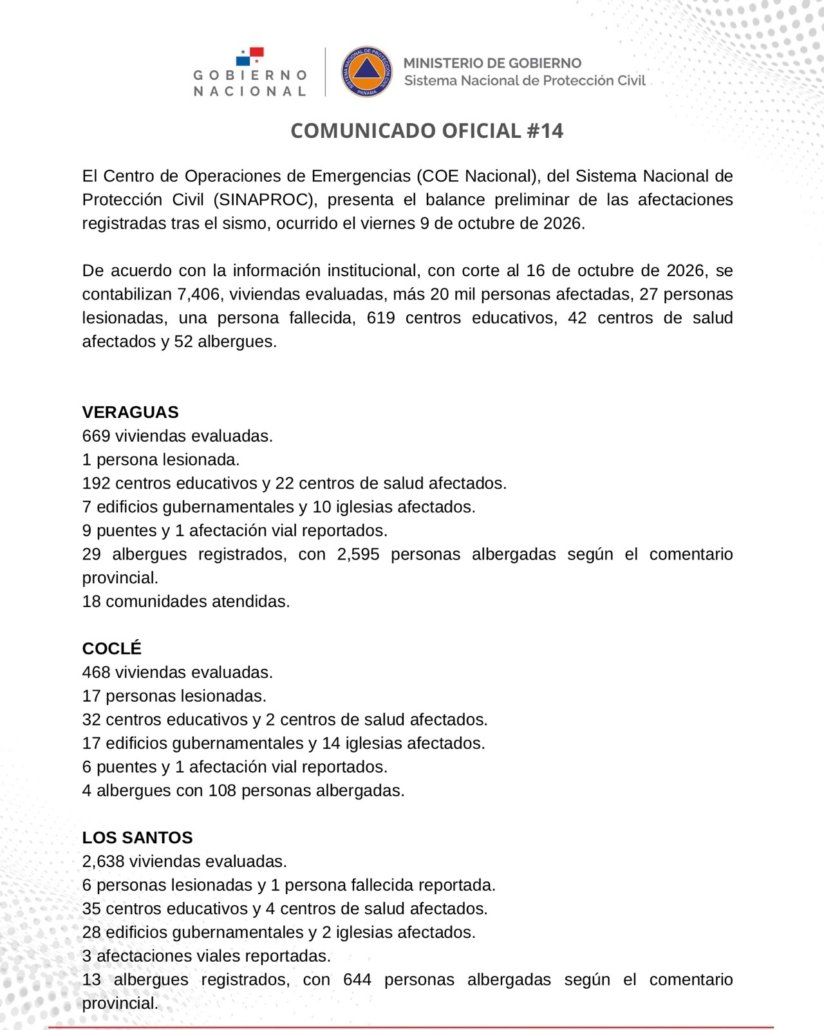
Of the 6,811 homes inspected as of that date, 1,627 (23.9%) have total damage, 4,184 (61.4%) have moderate or partial damage, and 1,000 (14.7%) have minor damage, according to Sinaproc data reported by Infobae. In other words, nearly one in four homes assessed cannot be repaired.
Damage by province
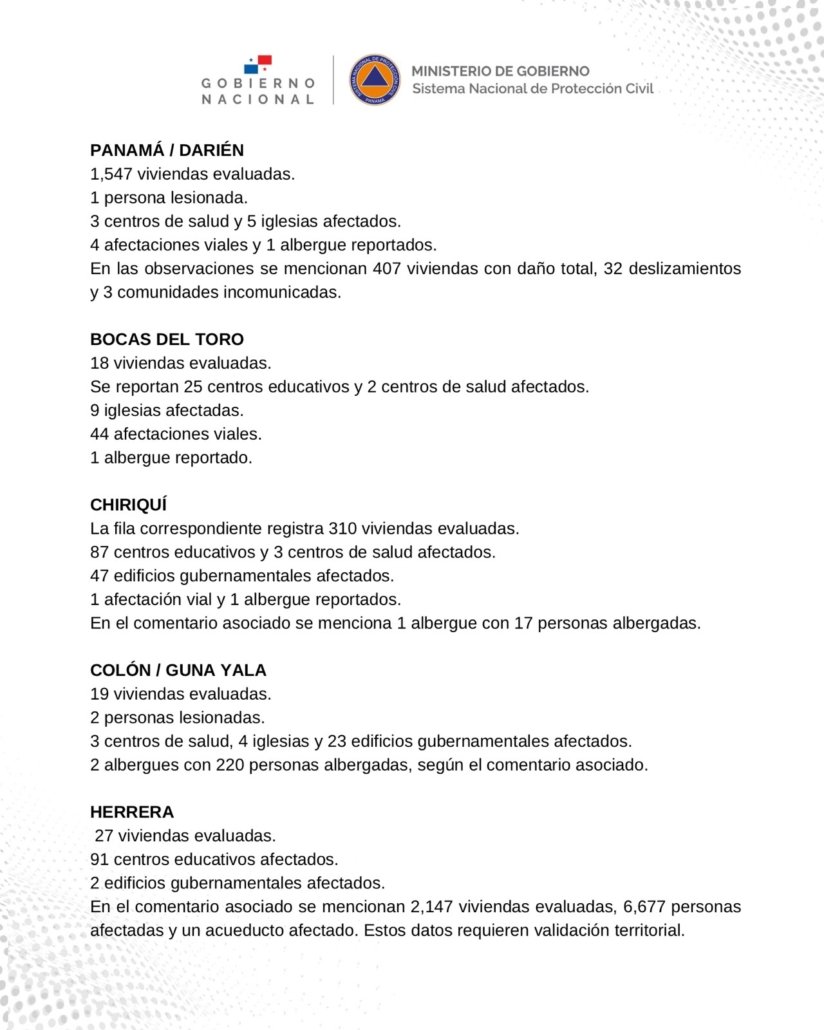
This is how the impacts break down, according to the same Sinaproc bulletin:
| Province or indigenous region (comarca) | Homes assessed | Injured | Schools affected | Health centers affected | People in shelters |
|---|---|---|---|---|---|
| Los Santos | 2,638 | 6, plus 1 death | 35 | 4 | 644 |
| Panama / Darién | 1,547 | 1 | — | 3 | — |
| Veraguas | 669 | 1 | 192 | 22 | 2,595 |
| Coclé | 468 | 17 | 32 | 2 | 108 |
| Chiriquí | 310 | — | 87 | 3 | 17 |
| Panamá Oeste | 76 | — | 18 | — | — |
| Ngäbe-Buglé Comarca | 35 | — | 51 | 1 | 138 |
| Herrera* | 27 | — | 91 | — | — |
| Colón / Guna Yala | 19 | 2 | — | 3 | 220 |
| Bocas del Toro | 18 | — | 25 | 2 | — |
- Los Santos: the province with the most homes assessed and the only one with a death. In Tonosí, near the epicenter, about 100 homes were destroyed or severely damaged, and an apartment building collapsed in Playa Venao (Pedasí).
- Veraguas: the province with the most schools and health facilities affected and the most people in shelters. Several rural water systems collapsed in Mariato.
- Coclé: the province with the most injuries. In Penonomé, the San Juan Bautista Cathedral and the provincial Governor’s Office building suffered structural damage.
- Panama and Darién: the bulletin reports 407 homes with total damage, 32 landslides, and 3 communities cut off.
- Public buildings and churches: 127 government buildings were affected, mainly in Chiriquí, Los Santos, Colón, and Coclé, along with 44 churches, many of them older structures.
- Roads and bridges: Sinaproc reports 15 bridges affected in Veraguas and Coclé, and 44 road incidents in Bocas del Toro alone. As of October 16, 92% of the affected roads had reopened, according to the government.
Earthquake aftershocks
The 2026 Panama earthquake has been followed by an intense aftershock sequence, concentrated between Soná, Tonosí, Coiba Island, and Santiago:
- First day: more than 55 aftershocks, 26 of them magnitude 5 or greater, according to the Pan American Health Organization.
- Strongest aftershock: magnitude 6.6 according to the USGS (6.9 according to the Institute of Geosciences), at 3:25 p.m. the same day, October 9, near Coiba.
- October 12: another magnitude 6.1 aftershock off Coiba, which was felt lightly in the capital.
- Total: more than 400 aftershocks recorded in the first four days.
Néstor Luque, director of the Institute of Geosciences, explained that the aftershocks continue but are decreasing in magnitude and becoming less frequent. This is normal after a large earthquake, although strong aftershocks may still occur for weeks or months.
Government response
- National emergency: the Cabinet Council declared it on October 10 and authorized up to $100 million for emergency response and the reconstruction of homes, schools, health centers, and infrastructure, according to Bloomberg Línea.
- Additional financing: the Inter-American Development Bank said Panama can access up to $300 million in contingent financing.
- Schools: the Ministry of Education suspended classes nationwide to inspect school buildings.
- Humanitarian aid: more than 148,900 pounds delivered by air and more than 331 tons by road, reaching 72 communities, with 52 shelters opened, according to Sinaproc.
- International cooperation: the United States, Mexico, Costa Rica, and Venezuela have sent aid.
Lessons from the earthquake for construction in Panama
The Azuero earthquake confirms what the history of earthquakes in Panama shows: no region of the country is free from strong earthquakes, and Azuero can produce earthquakes larger than magnitude 7. For the construction industry, it leaves four lessons:
- Housing is the most vulnerable. Nearly one in four homes assessed has total damage. Unreinforced masonry homes and owner-built homes perform the worst, just as happened in Panamá Viejo in 1621.
- Comply with the Panama Structural Code (REP) on every project, including single-family homes and the reconstruction now getting underway.
- Inspect before reoccupying. Diagonal cracks in columns or beams, doors that no longer close, or damage to stairs and joints require an evaluation by a structural engineer.
- Review public infrastructure. Schools, health centers, bridges, and rural water systems accounted for much of the damage and are key to recovery.
If your home, building, or project needs a structural assessment, our directory lists engineering and consulting firms in Panama that specialize in inspection and seismic retrofitting.
Frequently asked questions about the 2026 Panama earthquake
What was the magnitude of the October 9, 2026, earthquake in Panama?
Magnitude 7.7 according to the USGS. The Institute of Geosciences at the University of Panama first recorded it at 7.2 and later revised it to 7.5. It is the largest earthquake ever recorded in the country.
Where was the epicenter of the earthquake?
On the Azuero Peninsula, about 39 km (24 miles) northwest of Tonosí, near the border between Los Santos and Veraguas, at a shallow depth.
How many people were killed and injured in the Panama earthquake?
According to Sinaproc, as of October 16, 2026, one person had died in Los Santos and 27 people were injured. In addition, more than 20,000 people were affected.
How many aftershocks has the earthquake had?
More than 400 in the first four days. The strongest was magnitude 6.6 according to the USGS, on October 9. Aftershocks are decreasing in magnitude and frequency, although they may continue for weeks.
Was there a tsunami?
No. Precautionary alerts for possible waves were issued for the Pacific, but no tsunami was generated.
What should I do if my house has cracks after the earthquake?
Do not reoccupy it if there are diagonal cracks in columns or beams, doors that no longer close, or damage to stairs. Report the damage to Sinaproc and request an evaluation from a structural engineer before making repairs or going back inside.
Sources
- Sinaproc: official bulletin No. 14, October 16, 2026 (in Spanish).
- USGS: M 7.7, 12 km WSW of Pitaloza Arriba, Panama.
- Pan American Health Organization: Situation Report 1, Panama earthquake (in Spanish).
- Infobae: 23.9% of affected homes have total damage, October 17, 2026 (in Spanish).
- Bloomberg Línea: Panama declares a national emergency, October 10, 2026 (in Spanish).