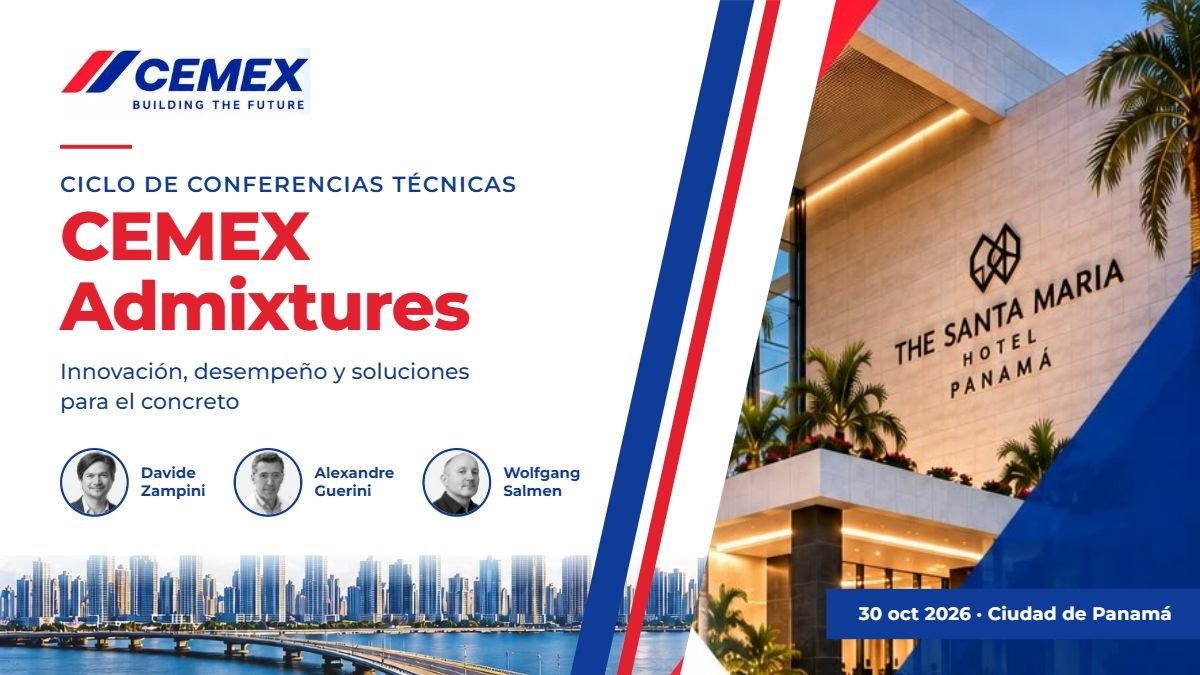
Concrete admixtures account for a tiny fraction of the cost of a cubic meter, but they determine how concrete flows, how strong it gets, how long it lasts, and how much CO2 it emits. That was the central idea of the Cemex Admixtures Technical Lecture Series, held on October 30, 2026, at The Santa Maria hotel in Panama City, with Cemex’s global Research and Development (R&D) team visiting from Switzerland.
The speakers were Davide Zampini, Cemex’s global vice president of R&D; Alexandre Guerini, director of Product Development and Industrialization; and Wolfgang Salmen, head of admixture technology and strategy. Speaking to Panamanian cement producers, ready-mix suppliers, precasters, and builders, they explained how admixtures are designed today and answered specific questions about the local market.
Summary: 5 key takeaways from the event
- At the right dosage, admixtures help maintain the stability and uniformity of the mix, especially in high-performance concrete or concrete with special requirements.
- Polycarboxylates (PCEs) are the fourth generation of superplasticizers and can reduce water demand by 40% to 50%.
- Cemex now synthesizes its own polymers, which allows it to tailor the molecule to the cement and aggregates of each market.
- According to the speakers, most concrete problems stem from poor practices, such as adding water on site, rather than a lack of technology.
- Conversations with customers should focus on the total cost of the project, not the price per cubic meter.
What is Cemex Admixtures and how does it operate in Panama?
Cemex Admixtures is Cemex’s admixtures business, with more than 70 years of global experience in this technology. It has operated in Panama since 2015. As Edgar Chang of Cemex Admixtures in Panama explained, the company does not currently produce cement or concrete in the country, so it acts as a complementary supplier to cement producers and ready-mix companies rather than as their competitor.
Its development is supported by Cemex’s global R&D network: 3 global centers (Biel/Bienne in Switzerland, Monterrey, and Mexico City), 9 regional laboratories, more than 60 full-time employees of more than 27 nationalities, and more than 5,000 m² (54,000 sq ft) of laboratory space.
Why does the admixture define concrete performance?
Because it is the ingredient that allows cement, water, sand, and gravel to work together. Chang illustrated this with a 10-meter pile: without an admixture, when the mix is poured the water rises, the stone sinks, and the element does not work. With the right admixture, the mix reaches the bottom and stays uniform.
In the ready-mix concrete cost structure presented by Cemex, materials account for about 69% and transportation for about 20%. Within materials, the admixture is the smallest share. Even so, it plays a role in recycling returned concrete, retaining workability during transport, pumping, accelerating hardening, optimizing mix design, and reducing the CO2 footprint.
Zampini stressed that the entire chain is connected. If a cement producer reduces clinker to lower CO2 emissions but that cement does not perform in concrete, no one captures the value. That is why cement grinding aids and concrete admixtures must be designed with each other in mind.
What are polycarboxylates (PCEs) and how do they differ from other superplasticizers?
Polycarboxylates, or PCEs, are comb-shaped polymers: a main backbone attaches to the cement grain, and the side chains act like arms that keep the grains from clumping together (steric repulsion). They are the fourth generation of plasticizers and achieve the greatest water reduction.
| Family | Mechanism | Main characteristics |
|---|---|---|
| Lignosulfonates | Water-softening effect | Moderate water reduction (10–15%); can retard setting at high dosages |
| Naphthalenes (PNS) | Electrostatic repulsion | Strong initial plasticizing effect; structure difficult to tailor |
| Melamines (PMS) | Electrostatic repulsion | Good plasticizing effect; being phased out in Europe |
| Polycarboxylates (PCE) | Steric and electrostatic repulsion | Water reduction of up to 40–50%; structure can be custom-designed |
Changing the length of the side chains, the charge density, or the size of the molecule produces different behaviors. Some PCEs give high initial flow and lose it quickly, which is useful in precast. Others maintain workability for up to 6 hours without delaying strength development, unlike traditional retarders.
In-house, more robust polymers
Cemex went from buying admixtures to formulating them and, later, to synthesizing its own polymers. After characterizing more than 200 PCEs, the team concluded that four or five well-designed ones are enough to cover almost any need, and it developed a synthesis process that runs at a lower temperature and in fewer hours.
Salmen explained that earlier-generation PCEs had bonds that the calcium in concrete could break, reducing their robustness. The new chemistry avoids that weak point and includes components that compensate for variations in the gypsum in cement, one of the most common causes of cement-admixture incompatibility.
The superplasticizer range is organized into three tiers: the ISOFLOW 6000 series for everyday needs; the ISOFLOW 7000 and 8000 series, with in-house synthesis, for extended workability of more than 3 hours and viscosity control; and a new non-PCE chemistry designed for cements with high water demand, pozzolans, calcined clays, limestone, and low-quality aggregates.
What admixture solutions did Cemex present?
- Controlled acceleration: the concrete travels with a two-component system that activates at the planned time, instead of adding accelerator on site with a margin of about 30 minutes.
- Internal curing: an admixture built into the mix seals the surface, reduces shrinkage, and retains water for uniform hydration.
- Returned concrete turned into aggregate: one soluble bag per cubic meter turns leftover concrete into rounded granules inside the truck drum in about 7 minutes.
- Quarry fines turned into aggregate: with a small amount of cement and an admixture, dust stockpiled at quarries is turned into aggregates for various uses.
- Soil stabilization: the admixture is mixed with excavated soil to form road subbases without hauling in aggregates.
- 3D printing with ready-mix concrete: instead of bagged mortars, it prints concrete delivered by truck that changes consistency as it leaves the nozzle.
- Specialty concretes: lightweight concretes of more than 40 MPa with a density of 1.1, thermal insulating concretes, structural pervious concretes, and porous water-retaining concretes.
- High-ductility fiber-reinforced concrete: distributes cracking into microcracks, can be pumped with more than 60 kg of fiber per cubic meter, and allows thinner slabs with no joints and no reinforcing steel.
Which concrete challenges in Panama were discussed?
Pavement repair in 24 hours
A concrete producer described slab replacement on Panama’s expressways: one day to demolish and another to pour, with concretes that must reach 650 psi flexural strength in 24 hours. To avoid falling short in testing, mixes are designed with a margin of 10% to 15% above the target. The Cemex team proposed combining high-ductility fiber-reinforced concrete with cement selection and an acceleration system.
Manufactured sand and self-consolidating concrete
The manufactured sands that public works often require absorb a lot of water. When their moisture changes, the same admixture can make a self-consolidating concrete gain flow during transport or become too viscous. Salmen attributed this to excess free water, which leaves polymers unadsorbed. His recommendation: remove the late-adsorbing components, use a medium-reactivity polymer, and achieve workability retention another way. Guerini added a key practice: always keep aggregates saturated.
Flowable concrete without increasing cement content
Many customers ask for slabs with a 20 cm slump even though they specify 10 cm. Zampini proposed self-consolidating concretes with 320 kg of fines per cubic meter or less, using a viscosity-modifying admixture that acts as a “liquid fine.” As he explained, good dispersion allows practically all the cement to hydrate, so more cement is not always needed to achieve more strength.
How can you justify the cost of a higher-tech concrete?
The speakers recommended moving away from debating the price per cubic meter and talking about the total cost of the project, in which concrete represents about 10%. In an industrial floor, for example, a more expensive fiber-reinforced concrete can reduce thickness, eliminate joints and steel, and free up space for racking.
Chang offered two local examples. Ricardo J. Alfaro Avenue, built in concrete in the 1960s, has never needed resurfacing. And a pilot section of short-slab whitetopping, 10 to 15 cm thick compared with 30 cm for a conventional pavement, has not been repaved since 2014–2015. Even so, he lamented, the technology has not become widespread.
For Zampini, the underlying challenge is cultural: “The concrete industry’s worst enemy is ourselves.” Several attendees agreed that more technical training is needed so that site foremen and new generations adopt technologies that already exist.
What role do admixtures play in decarbonizing cement?
According to Zampini, reducing the clinker factor is currently the most tangible lever for lowering cement emissions. Carbon capture can cost between 100 and 220 euros per ton and faces permitting and transport barriers. In Europe, there are already cements with about 50% clinker, and it is admixtures that allow them to perform like conventional cement.
Cemex is also working on admixtures made from waste and from biological sources, on non-metallic fibers, and on methods for recovering fibers when a structure is demolished.
Frequently asked questions about concrete admixtures
What is a superplasticizer admixture used for?
It disperses cement particles to produce a more flowable concrete with less water. This lowers the water-cement ratio, improves strength, and makes pumping and placement easier.
How much water does a polycarboxylate reduce?
According to the Cemex presentation, PCEs can reduce water demand by 40% to 50%, compared with 10–15% for lignosulfonates.
Why shouldn’t water be added to concrete on site?
Because it increases the water-cement ratio and reduces strength and durability. Using an admixture that maintains workability during transport removes the temptation to add water.
What is internal curing of concrete?
It is a method in which an admixture in the mix retains water and releases it evenly, so the concrete hydrates properly and cracks less even if external curing is poor.
Can concrete returned to the plant be reused?
Yes. With a specific admixture, leftover concrete is turned into aggregate inside the mixer truck itself and, once hardened, can be reused.
Conclusion
The Cemex Admixtures event in Panama delivered a practical message: much of the technology for making more efficient, durable, and sustainable concrete already exists. Admixtures have become solutions tailored to each raw material, project, and haul distance, and getting the most out of them depends on testing, adjusting, and improving site practices together with suppliers.