In a country where urban growth is moving fast and infrastructure faces new environmental, technical, and social challenges, sustainable design can no longer be treated as an architectural trend or an image strategy. In Panama, building sustainably means rethinking how projects are conceived from the earliest stages: location, orientation, use of resources, energy efficiency, material selection, construction planning, and above all, the impact each building will have on people’s lives and their surroundings.
This content is part of the ConstructHUBS digital issues, within our editorial line dedicated to sustainability applied to the construction industry.
From that comprehensive perspective, architect Elida Melgar, who holds a master’s degree in Construction Project Management and teaches at the university level, offers a view that combines experience in civil projects, construction management, technical training, visualization, and project management.
Her perspective shows that sustainability does not begin when a “green” material is chosen, nor does it end with a more efficient facade. On the contrary, it starts with planning, coordination between disciplines, smart use of technology, and the ability to anticipate decisions that prevent waste, rework, and cost overruns.
You can also read the version published in the June 2026 issue of ConstructHUBS (in Spanish).
Sustainable design as a professional and shared responsibility
Talking about sustainable design in Panama today means much more than putting an environmental label on a project or choosing “green” materials because they are trendy. In professional practice, sustainable design should be understood as a complete way of looking at a project: how it is planned, how it is built, and above all, how people will live in it.
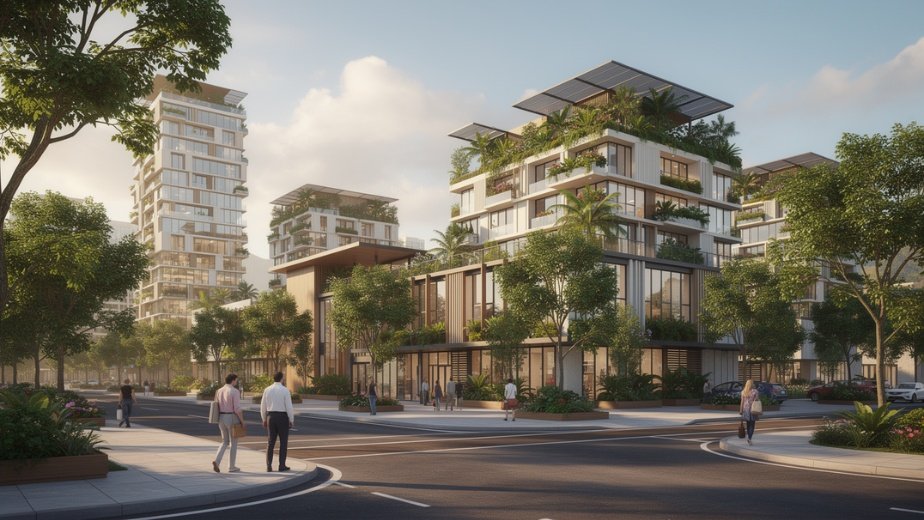
A sustainable approach requires thinking about the tropical climate, integrating vegetation, reducing energy use, making better use of available resources, and making decisions that respond to both technical and human criteria.
In that sense, sustainability is not only an environmental goal. It is also a way to improve quality of life, optimize investment, reduce errors during construction, and create projects that are more consistent with real site conditions.
Relevant trends for residential, commercial, and institutional projects
Among the main sustainable design trends for new residential, commercial, and institutional projects in Panama, climate-responsive design stands out. This involves analyzing building orientation, solar exposure, natural ventilation, vegetation, energy use, and the selection of materials with lower environmental impact.
Another important trend is the use of digital tools to design and build with greater precision. Technology makes it possible to visualize projects better, detect problems before they reach the site, and coordinate disciplines more efficiently.
Sustainable design is also tied to a culture of quality. Proposing good ideas on the drawings is not enough if, during construction, materials are swapped without technical analysis, solutions are improvised, or quality control is neglected.
Planning from the earliest stages of the project
Good planning from the start leads to better construction. When the project’s goals are clear and the architecture, structure, MEP systems, and budget are coordinated around a shared vision, the work moves forward with less waste, less rework, and fewer last-minute decisions.
Often, construction problems do not really originate on the job site but earlier, in a design phase that was incomplete, poorly coordinated, or rushed.
That is why planning is also a sustainable decision. It makes it possible to anticipate technical risks, optimize resources, organize purchasing, reduce improvised changes, and protect the final quality of the project.
Technology, digital visualization, and computer-aided design tools
Technology plays a fundamental role in developing more sustainable, better-coordinated projects. Tools such as computer-aided design, BIM modeling, digital visualization, virtual walkthroughs, and three-dimensional coordination make it possible to study a project more clearly before it goes to the site.
These tools do not replace professional judgment or the architect’s experience, but they do help reveal what might previously have gone unnoticed. They make it possible to anticipate conflicts, compare alternatives, communicate decisions more clearly, and detect clashes between systems.
A well-developed digital model can help calculate quantities more accurately, visualize daylighting, study ventilation, optimize circulation, and make it easier for clients, consultants, and builders to understand the project.
Technology turns design into a more collaborative, measurable, and efficient process.
Sustainability in budget, schedule, and supplier selection
Sustainability should not appear at the end as an add-on once the most important decisions have already been made. It should be part of project management from the very beginning.
This means looking beyond the initial cost of a material or system. It also means evaluating its durability, the maintenance it will need, its local availability, its efficiency, its environmental impact, and its performance over time.
From a project management standpoint, working with sustainable criteria requires planning purchases carefully, reducing waste, verifying specifications, and making sure that what was designed is actually built on site.
A sustainable project needs consistency between what is proposed in the design and what is ultimately built. Sustainability also means order, traceability, coordination, and compliance.
The role of academia in the construction industry’s new challenges
New generations of architects arrive with greater awareness of environmental, urban, and technological challenges. Many students already understand that architecture cannot be limited to creating attractive forms; it must respond to real problems such as climate change, unplanned urban growth, energy use, mobility, and people’s quality of life.
However, the challenge remains of strengthening technical training, critical thinking, and the ability to connect theory with technology and construction practice.
Sustainability should not be taught as a stand-alone subject, but as an approach present throughout the entire process: from design to construction and project management.
Building better through awareness and coordination
Sustainable design in Panama requires a broader view of the construction process. It is not only about choosing efficient materials or adding vegetation, but about designing with the climate in mind, planning more precisely, coordinating disciplines, reducing waste, and building responsibly.
Sustainability should be understood as an ongoing practice that involves architects, engineers, developers, builders, suppliers, educators, students, and users.
Building better means making more conscious decisions from the start. And in a rapidly growing urban environment, that awareness can make the difference between projects that simply take up space and projects that truly add value to the city.