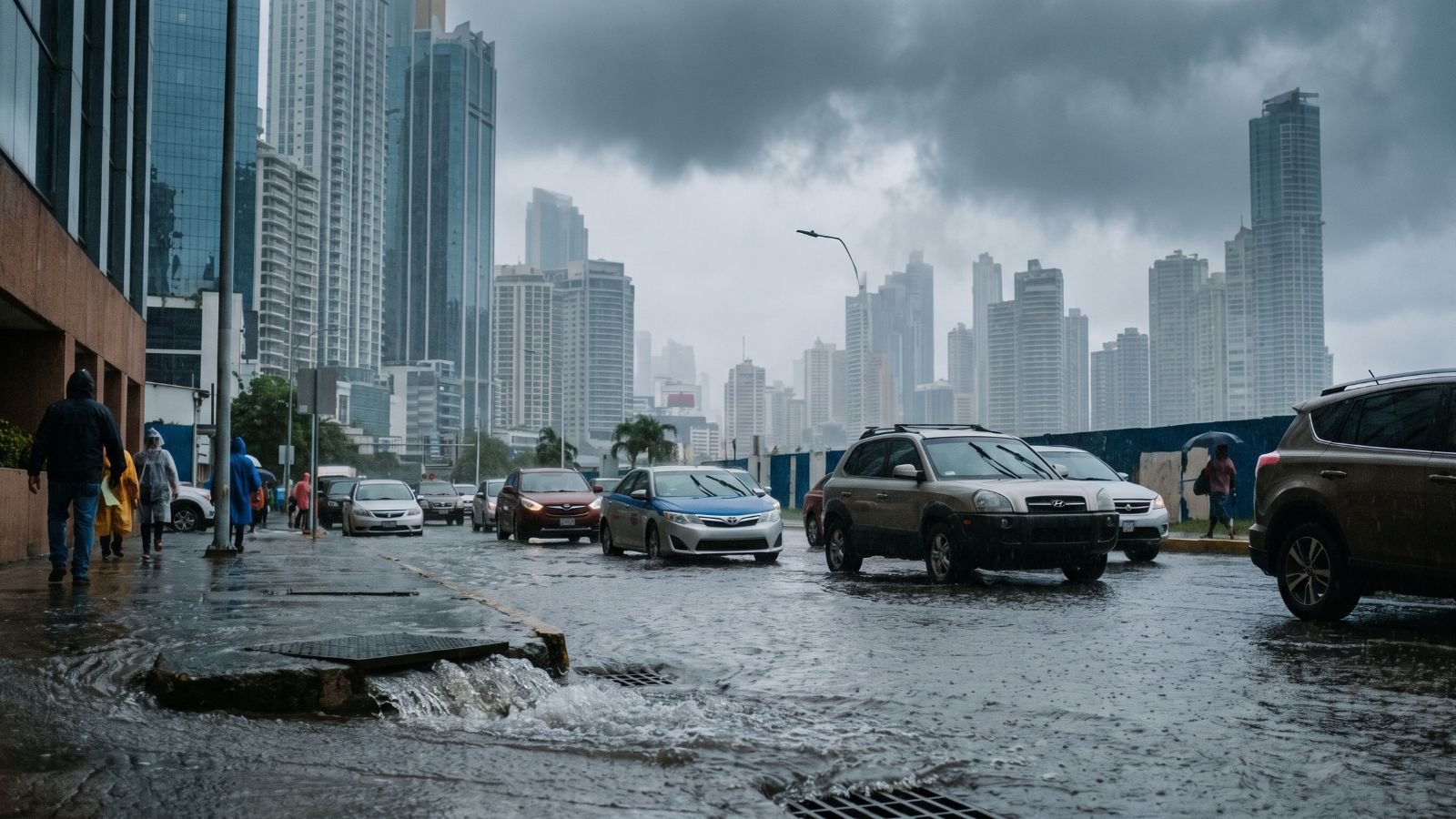
The recurring floods in Vía Argentina, Juan Díaz, Chanis or Río Abajo are not isolated events: they show that Panama’s traditional urban drainage model has reached its limit. More impervious surfaces, more intense rainfall and the influence of tides have exceeded the capacity of the storm networks. The answer, according to modern engineering, is to manage water rather than just remove it: Sustainable Urban Drainage Systems (SUDS), sponge parks, detention ponds and permeable pavements.
This article was originally published in our construction digital magazine, within the editorial line dedicated to sustainability applied to the construction industry.
The analysis is by Eng. Arquímedes Fernández, a licensed engineer (JTIA) with a postgraduate degree in Structural Engineering and a diploma in Construction Project Management. His conclusion: Panama already has the technical tools and the regulatory backing; the challenge is turning them into planning, enforcement and concrete projects.
You can also read the version published in the July 2026 issue of ConstructHUBS magazine (in Spanish).
Why does Panama City flood?
For decades, hydraulic design was based on climate conditions and levels of urbanization very different from today’s. Three factors now converge:
- Soil sealing: buildings, streets, parking lots and sidewalks reduce natural infiltration and increase the volume and speed of runoff.
- More intense rainfall: climate change has increased the intensity and frequency of extreme rain, reflected in IDF (Intensity-Duration-Frequency) curves.
- Tides: they limit discharge into receiving water bodies.
The combination means storm networks often operate above their design capacity.
What happens when heavy rain coincides with high tide?
The so-called backwater effect occurs. Storm networks normally discharge by gravity into streams, rivers or the sea. At high tide, the level of the receiving body rises and the hydraulic gradient needed to evacuate the water drops.
If heavy rain falls at the same time, pipes run full or under pressure, the hydraulic grade line rises and water backs up inside the system. Inlets and manholes overflow and streets flood. “Put simply, pipes can drown too,” Fernández explains.
Why is “pipe it and drain it” no longer enough?
The classic principle of urban drainage was to capture water quickly and convey it through pipes to a discharge point. It worked when cities were less dense, had more permeable areas and less intense rain.
Under current conditions, increasing pipe diameters no longer solves the problem. Modern engineering combines gray infrastructure (pipes, pumping, gates) with green infrastructure that retains, temporarily stores, infiltrates and regulates flows. “The goal is no longer just to evacuate water, but to manage it intelligently along its entire path.”
What is a sponge city?
It is a city designed to behave like a natural ecosystem: it captures, infiltrates, stores, reuses and gradually releases rainwater. Instead of sending all the water straight to the storm system, it includes spaces that absorb part of the runoff and reduce peak flows.
In Panama, according to Fernández, the model can be applied with floodable parks, sunken pocket parks, detention ponds, underground reservoirs, rain gardens, permeable pavements, infiltration trenches, green roofs and ecological corridors.
What are SUDS and what benefits do they offer?
Sustainable Urban Drainage Systems (SUDS) are engineering solutions that aim to reproduce the natural hydrological cycle of the land before urbanization. They promote infiltration, retention, temporary storage, evaporation, bioretention and controlled discharge. Their main benefits:
- They reduce peak flows during storms and the risk of flooding.
- They improve water quality by filtering pollutants.
- They recharge aquifers.
- They reduce the hydraulic load on existing networks.
- They increase green areas and improve the urban landscape.
- They help cities adapt to climate change.
The Ministry of Public Works’ Manual of Requirements for the Review and Approval of Plans, adopted by Resolution No. 067 of April 12, 2021, already includes criteria promoting retention, attenuation and sustainable drainage measures in new projects.
Which solutions are most urgent for Panama?
There is no single solution; the answer must be adapted to each watershed. Fernández’s priorities:
- Detention ponds and temporary reservoirs in the most flood-prone watersheds.
- Sponge or floodable parks: recreational in normal conditions and storage during storms.
- Permeable pavements in parking lots, sidewalks and public spaces.
- Rain gardens, infiltration trenches and bioretention in new developments.
- Oversized storm networks that temporarily store water when tides limit discharge.
- Pumping stations and backflow-prevention gates where gravity discharge is insufficient.
If the regulations exist, what is missing?
The challenge is no longer regulatory but one of implementation. Besides the MOP manual, Panama has the Urbanization Regulations, the Panamanian Structural Code (REP) and DGNTI-COPANIT standards. Fernández also proposes improving the MIVIOT manuals on floodable parks and retention ponds. What is needed:
- More rigorous hydrological and hydraulic studies, with climate change and sea-level rise scenarios.
- Periodic updates of the IDF curves used in design.
- Enforcement to ensure approved measures are actually built.
- Incentives to incorporate green infrastructure from the conceptual stage.
- Integrating urban planning with watershed management instead of analyzing each project in isolation.
This approach connects with other urban climate challenges, such as the urban heat island effect in Panama, which the same author analyzed in a previous issue.
Frequently asked questions about sustainable drainage
What are IDF curves?
Intensity-Duration-Frequency curves relate rainfall intensity to its duration and probability. They are used to size drainage and should be updated as rainfall patterns change.
What is a detention pond?
A space that temporarily stores rainwater and releases it in a controlled way, reducing the flow reaching the networks during a storm.
Do Panamanian regulations address sustainable drainage?
Yes. The MOP manual adopted by Resolution No. 067 of 2021 includes retention, attenuation and sustainable urban drainage criteria for new projects.
From fighting water to living with it
“The most resilient cities are not those that fight water, but those that learn to live with it, store it, regulate it and use it safely,” Fernández concludes. Engineering already has the knowledge, technology and regulatory backing; the challenge is turning them into projects through technical planning, institutional coordination and effective enforcement.