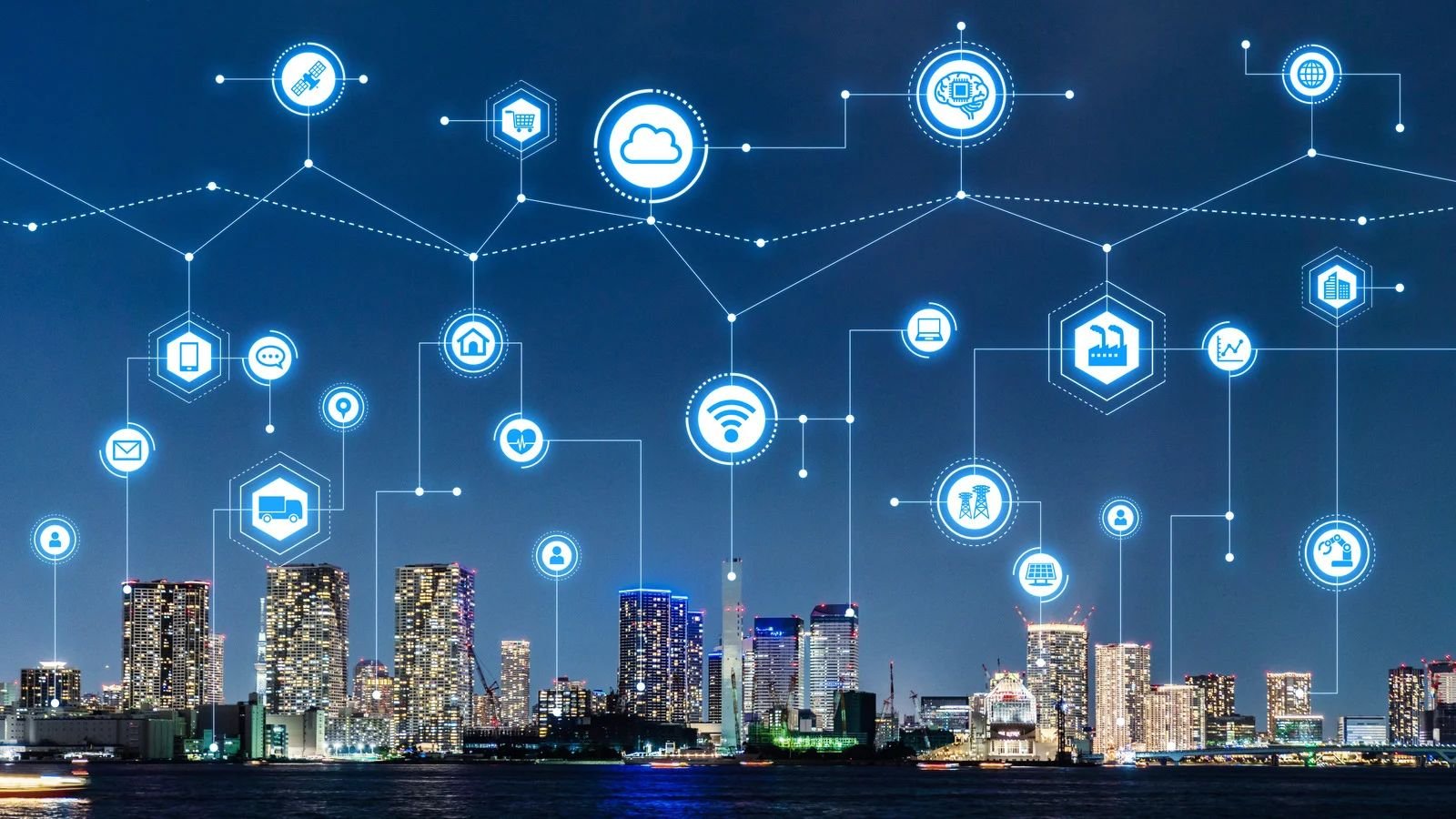
A smart building is a building that integrates and coordinates its systems (HVAC, lighting, security, access, energy and communications) to operate efficiently and adapt in real time to how the building is actually used. Unlike a traditional building, where each system works separately, data from IoT sensors feeds a central platform that optimizes consumption, improves security and reduces maintenance.
This content is part of our construction magazine for the Americas, within the editorial line dedicated to technology and innovation in construction.
The explanation comes from Eng. Joel Sánchez, mechanical engineer from UTP with a master’s in Project Management (UIP) and an MBA from INESEM Business School, an active member of CIEMI-SPIA and an auditor and consultant on megaprojects.
You can also read the version published in the December 2025 issue of Construcción en Panamá magazine (in Spanish).
What exactly is a smart building?
Although smart buildings are talked about as something new, their roots go back to the 1960s, when the first HVAC systems incorporated monitoring and control devices. A smart building is the evolution of that automation:
- It integrates advanced technologies and connects all of the building’s systems.
- It optimizes the use of energy and resources.
- It improves security and the user experience.
- It adapts to the building’s real behavior.
In Panama the concept is gaining relevance due to the modernization of projects and regulations such as the Sustainable Building Regulation, which promotes energy efficiency in new construction.
Why are they a necessity rather than an option?
According to the data Sánchez cites, almost half of the world’s energy is consumed in buildings and around 25% of greenhouse gas emissions come from their operation. Governments, companies and owners are therefore looking for lower consumption, more operational control, better security and accessibility, lower maintenance costs and measurable sustainability.
Key features of a smart building
Not every automated building is a smart building. It must have:
- Full integration of systems: HVAC, lighting, security, access and energy.
- Robust physical and cyber security.
- Accessibility and ergonomics, with clear evacuation routes.
- Efficient energy use with continuous monitoring and automatic optimization.
- Operational flexibility for present and future needs.
- Natural interaction between the user and the technology.
- Sustainable, high-performance materials.
Home automation vs. building automation: what’s the difference?
| Home automation (domótica) | Building automation (inmótica) | |
|---|---|---|
| Scope | Homes and small spaces | Commercial and industrial buildings |
| Examples | Sensors, actuators, smart lighting, cameras, thermostats, remote control | Zoned lighting, integrated HVAC, corporate access control, BMS, real-time energy management |
| Reach | Individual actions | Coordinates the whole building |
What does a building need to be smart?
- Smart IoT sensors that collect data and connect systems in real time.
- An integration platform that processes information, displays indicators and enables centralized supervision.
- Sustainable materials, recyclable and durable, such as aluminum and steel.
- Environmental and operational strategies: water management, renewable energy and analysis of consumption patterns.
Systems that are integrated
- Smart HVAC-R: one of the largest energy consumers. It uses smart thermostats, occupancy sensors and direct digital control (DDC).
- Advanced lighting: more than 10% of a building’s consumption. It includes presence detectors, automatic dimming, scheduling and KNX integration.
- Integrated security: fire detection, access control, intrusion monitoring and automated evacuation.
- Energy efficiency: tools such as BIM make it possible to simulate consumption and optimize design decisions.
- Telecommunications: connect all systems and let users interact with them from any device.
- Artificial intelligence + IoT: failure prediction, self-management and automatic adjustments based on usage patterns.
Benefits and return on investment
Among the benefits Sánchez highlights are lower energy consumption, safer operation, more comfortable users, data-driven decisions, less corrective maintenance and longer system life. He estimates a return on investment of between 2 and 5 years.
Implementation challenges
- High initial investment in technology and integration.
- Lack of user training.
- Cybersecurity risks if systems are not robust.
- The need for prior technical studies to estimate the real return.
Frequently asked questions about smart buildings
What is a BMS?
A Building Management System, which integrates and supervises installations such as HVAC, lighting and energy.
Is an automated building already a smart building?
Not necessarily. It must integrate all of its systems, manage resources automatically and improve its performance using data.
How long does it take to recover the investment?
According to Eng. Sánchez, the estimated payback is between 2 and 5 years, although it depends on a prior technical study of each project.
The future of buildings has already begun
Smart buildings bring together engineering, sustainability, user experience and technology. They not only reduce costs and improve operations: they create safer, more human and more efficient environments. To explore the design side, see our article on sustainable design in Panama.