An environmental liability, such as an abandoned open-pit mine, can become useful infrastructure if the work starts from a rigorous geotechnical, geological and hydrogeological assessment. The case of Minas do Leão in Brazil proves it: a 129-hectare, 40-meter-deep mining pit was transformed into the largest sanitary landfill in Rio Grande do Sul, with biogas capture, power generation and economic benefits for the municipality.
This article was originally published in our construction digital magazine, within the editorial line dedicated to sustainability applied to the construction industry.
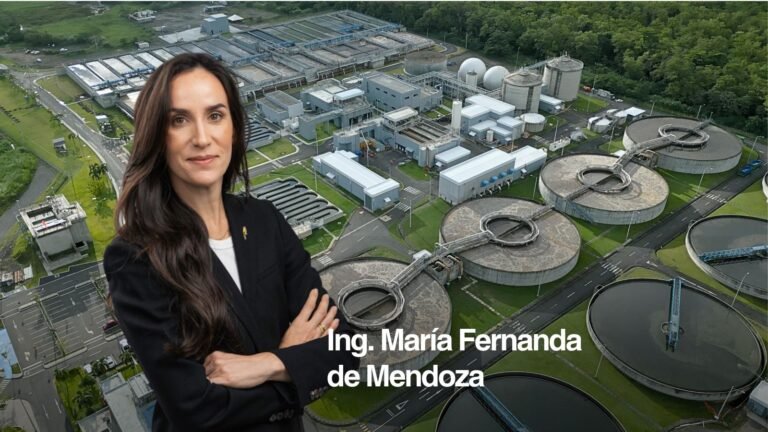
It is explained by Keli Correa, PhD, geologist and consultant, professor at the University of Panama’s Faculty of Engineering and of Civil Engineering at the Technological University of Panama (UTP), who took part in the project’s studies. “Applying engineering with awareness was my way of giving something back to the planet,” she says.
You can also read the version published in the November 2025 issue of Construcción en Panamá magazine (in Spanish).
What is a mining environmental liability?
It is the set of impacts an activity such as open-pit mining leaves behind when it ends: large areas of degraded land, altered soils, exposed aquifers and communities living next to them. For Correa, the technical and ethical question is what real solutions professionals can propose to reverse that damage and turn “scorched earth” into functional, resilient spaces.
The Minas do Leão case: from mine to landfill
The area saw intense mining activity since the 19th century. What remained was a pit of 129 hectares and 40 meters deep, unsuitable for reservoirs or urban development. New environmental rules on municipal solid waste created an opportunity: using that already degraded space for a technically controlled sanitary landfill.
Why is it a replicable model?
Because it started from a multidisciplinary assessment: permeability studies, slope stability, characterization of local waterproofing materials and an exhaustive hydrogeological evaluation.
The technical challenges
- Proving that the geology and hydrogeology of the former mine met the standards for a large-scale landfill.
- Mapping the subsurface, installing piezometers to monitor groundwater and testing soil and rock samples in the lab.
- Identifying low-permeability formations such as siltstones and shales, and evaluating local clays as impermeable layers.
- Earning the trust of authorities and the community, achieved through technical backing and environmental compliance.
Social, economic and energy impact
- The municipality, with just over 7,500 inhabitants, hosts the largest sanitary landfill in Rio Grande do Sul.
- It receives waste from 78 municipalities, about 15% of the state’s total.
- It provides around 18% of municipal tax revenue and generates direct and indirect jobs.
- During the 2024 floods it served as logistical support for handling more than 300,000 tons of waste.
- Its biogas capture and use system was approved by the UN in 2007 under the Kyoto Protocol’s Clean Development Mechanism, and generates enough power for about 100,000 people.
- In 2025 the first biomethane plant at a landfill in Rio Grande do Sul opened there, with a 30-million-dollar investment that is expected to avoid one million tons of greenhouse gases over 15 years.
What can Panama learn?
Correa compared Minas do Leão with Cerro Patacón. Her conclusions:
- Minas do Leão receives almost twice as much waste as Cerro Patacón, but with technological and energy control.
- Cerro Patacón has engineering deficiencies, fires and urban proximity, which increase its impacts.
- The Brazilian model operates under a circular economy logic, with energy recovery.
- Panama is in transition toward more modern management and can learn from experiences like this one.
Her message to Panamanian professionals: “where others see problems, we must see opportunities.” Civil engineering has the tools, but needs political will, smart investment and serious technical assessments. That same starting point, knowing the ground, is at the heart of her view on the geotechnical study in Panama.
Frequently asked questions
Can an open-pit mine be reused?
Yes, if a geotechnical and hydrogeological assessment shows it is compatible with the new use, such as a controlled sanitary landfill.
What is biomethane?
Upgraded biogas that can be used as a clean fuel, for example for industrial use.
Today’s degradation, tomorrow’s sustainability
For Correa, the project shows that civil engineering is not just design and construction, but also strategic vision, environmental responsibility and social commitment. “Today’s degradation can be tomorrow’s sustainability, if we apply engineering with awareness.”