In a parking structure, a painted line guides the driver but does not stop a vehicle: slab edges, ramps and open perimeters need vehicle restraint systems designed to withstand an impact. Pretensioned cable barriers, derived from post-tensioning technology, absorb part of the collision energy progressively and transfer the forces to the structure.
This content is part of the ConstructHUBS digital issues, within our editorial line dedicated to civil and structural engineering.
The article is based on the experience of PT Solutions Panamá (PTS), which designs and installs the PT-Guard™ cable barrier system.
You can also read the version published in the August 2026 issue of ConstructHUBS magazine (in Spanish).
A parking structure is a risk zone
Moving vehicles, pedestrians, ramps, level changes, slab edges and entrances all meet there. Its design must consider safety from the start: stall layout, aisle width, maneuvering areas, ramps and pedestrian routes. But also what happens if a driver loses control or accelerates by mistake.
How do cable barriers work?
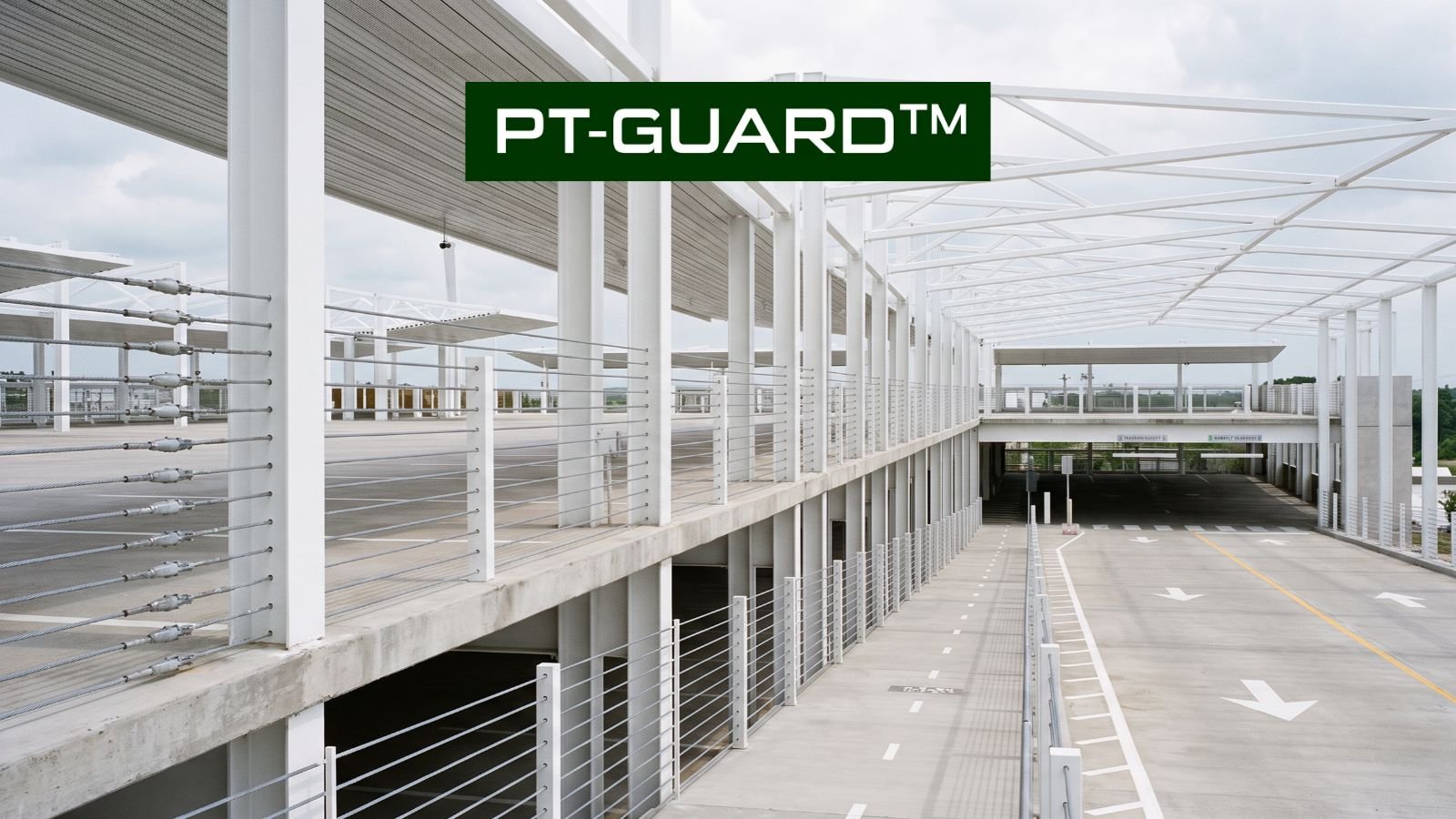
They use galvanized prestressing steel cables and anchors that transfer forces to the structure. Unlike a rigid barrier, the cables absorb part of the energy through a progressive response. They are used on:
- Slab edges and open perimeters.
- Elevated parking decks.
- Vehicle ramps and level changes.
- Areas with a risk of a vehicle accidentally leaving the structure.
They can be installed in new projects and in existing structures.
What load must a vehicle barrier withstand?
As a minimum criterion, the structural analysis considers a static load of 6,000 lb applied over a 12 × 12 inch area located between 18 and 27 inches above the driving surface. According to PTS, its system is also evaluated for the dynamic impact load, based on the vehicle’s mass and speed, because real forces can far exceed that static reference.
The components follow Post-Tensioning Institute and ACI 318 criteria, as well as the Panamanian Structural Code and JTIA requirements.
It can also protect pedestrians
If the number, spacing and height of the cables meet the corresponding requirements, the same barrier can also serve as pedestrian protection.
Safety without closing in the building
Using slender horizontal elements, the system keeps visual permeability, lets light and air through and avoids the closed-in feeling of a solid barrier.
Not a last-minute accessory
A barrier’s performance depends on its integration with the structure: anchors, cable layout and height, location and design loads. That is why it must be defined in the structural design. Parking structures are often built with post-tensioned slabs, from the same technological family.
Frequently asked questions
Is a cable barrier safer than a wall?
Not necessarily safer, but it responds differently: it absorbs energy progressively and preserves ventilation and visibility, provided it is well designed and anchored.
Can it be installed in an existing parking structure?
Yes, after a structural analysis of the anchors and the slab.